SUSTAINABILITY at FUA
Sustainability is defined as the practical ability to meet society’s basic current needs without reducing or disrupting the standard of living of future generations and without limiting their needs and requirements related to daily life.
Sustainable development is a form of human societal development that does not exploit the environment for its economic or social growth, but rather is in harmony with it.
The principles of sustainability can be expressed by the circular economy slogan:
REDUCE – REUSE – RECYCLE
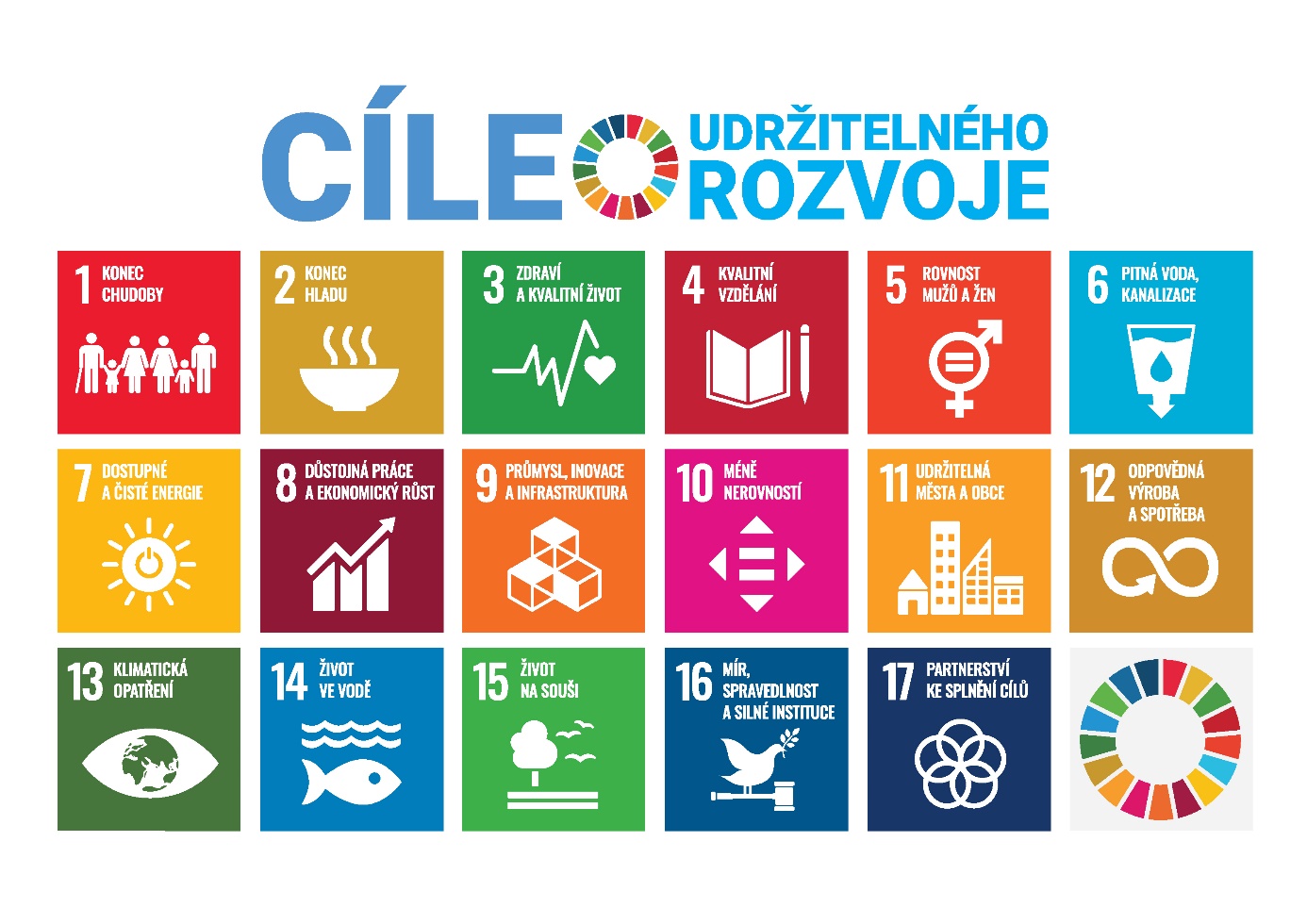
The concept of sustainable development is presented in the individual Sustainable Development Goals (SDGs), which are defined by the UN 2030 Agenda.
Universities around the world understand the need to change our lifestyle and recognize their irreplaceable role in this process.
Since 2022, TUL/FUA has been involved in the nationwide University Leaders in SDGs (UNILEAD) project, in which 24 Czech universities participated. The project’s goal was to intensify the contribution of universities in the field of sustainability, support the implementation of the SDGs, and protect our society and the environment. The common goal was to improve mutual coordination, share experiences, exchange available and practical knowledge, and, based on this, gradually develop a set of recommendations for the transparent and measurable expression of the established goals.
FUA was a member of the group for the following areas: Energy Management, Green Building and Water Management.
Building on experiences from the UNILEAD and UNILEAD I projects, FUA has also actively engaged in integrating sustainable practices into everyday school life.
FUA’s sustainable activities:
-
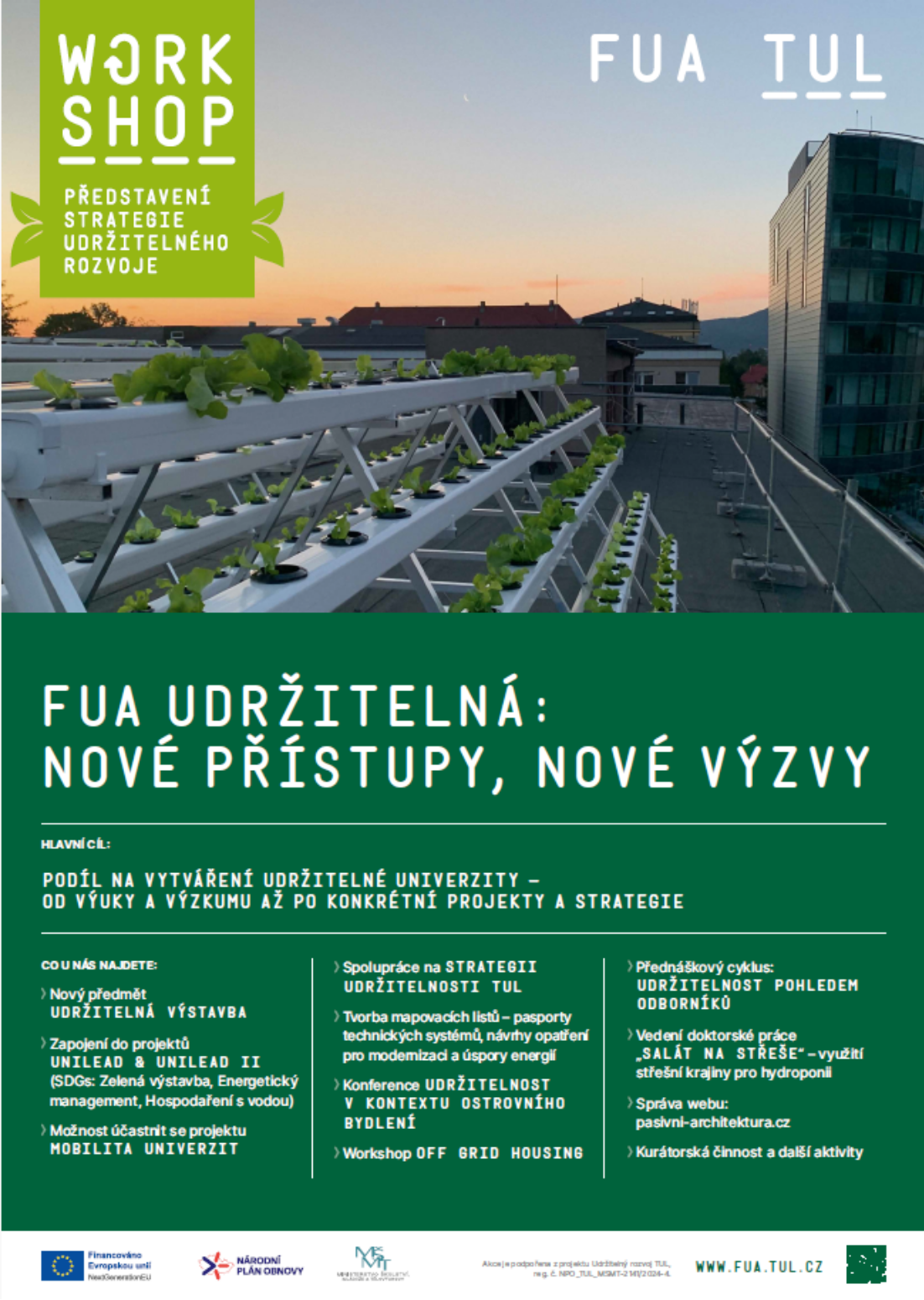
FUA, in collaboration with TUL’s technical building management, has developed its own mapping sheets for individual university buildings and campuses, which describe their current condition and identify areas where improvements could be made.
They focus primarily on the university’s technical systems, water management practices for all types of water, and waste management. Based on a precise geographical description of the locations of individual university buildings, they aim to apply the principles of climate-responsive design, which are then followed by specific technical solutions.
- Participation in the project “Supporting Green Skills and Sustainability at Universities” under Component 7.4 of the National Recovery Plan for the Higher Education Sector for 2024–2025—preparation and implementation of the new course Sustainable Construction and preparation of materials for the TUL Sustainability Strategy
- Student participation in the student research conference “Sustainability in the Context of Island Living,” held on May 14, 2024, at the Faculty of Architecture, Czech Technical University in Prague
- Workshop on Sustainable Construction – Fall 2024
- Lecture series on the topic of Sustainability: lecture “Sick Buildings” – November 28, 2024 - Ing. Lenka Prokšová Zuská, Ph.D., from the State Hydrological Institute in Prague, lecture "Sustainability and How to Achieve It" – December 12, 2024 - Marie Zemanová from the Association for Sustainable Business
- Preparation of materials for the HORIZON-MISS-2024-CIT-01-04 project – collaboration between FUA and external stakeholders
- Contribution to the development of the TUL Sustainable Development Strategy – Fall 2024
- SVK Sustainability in the Context of Island Living - December 19, 2024
- Finalization of a new master’s-level course in the Architecture and Urban Planning program: Sustainable Construction
- Preparation of a university-wide workshop – TUL Sustainable – October 1, 2025
ACADEMIC YEAR 2025–2026
- Organizational contribution to the university-wide workshop – TUL Sustainable – October 1, 2025
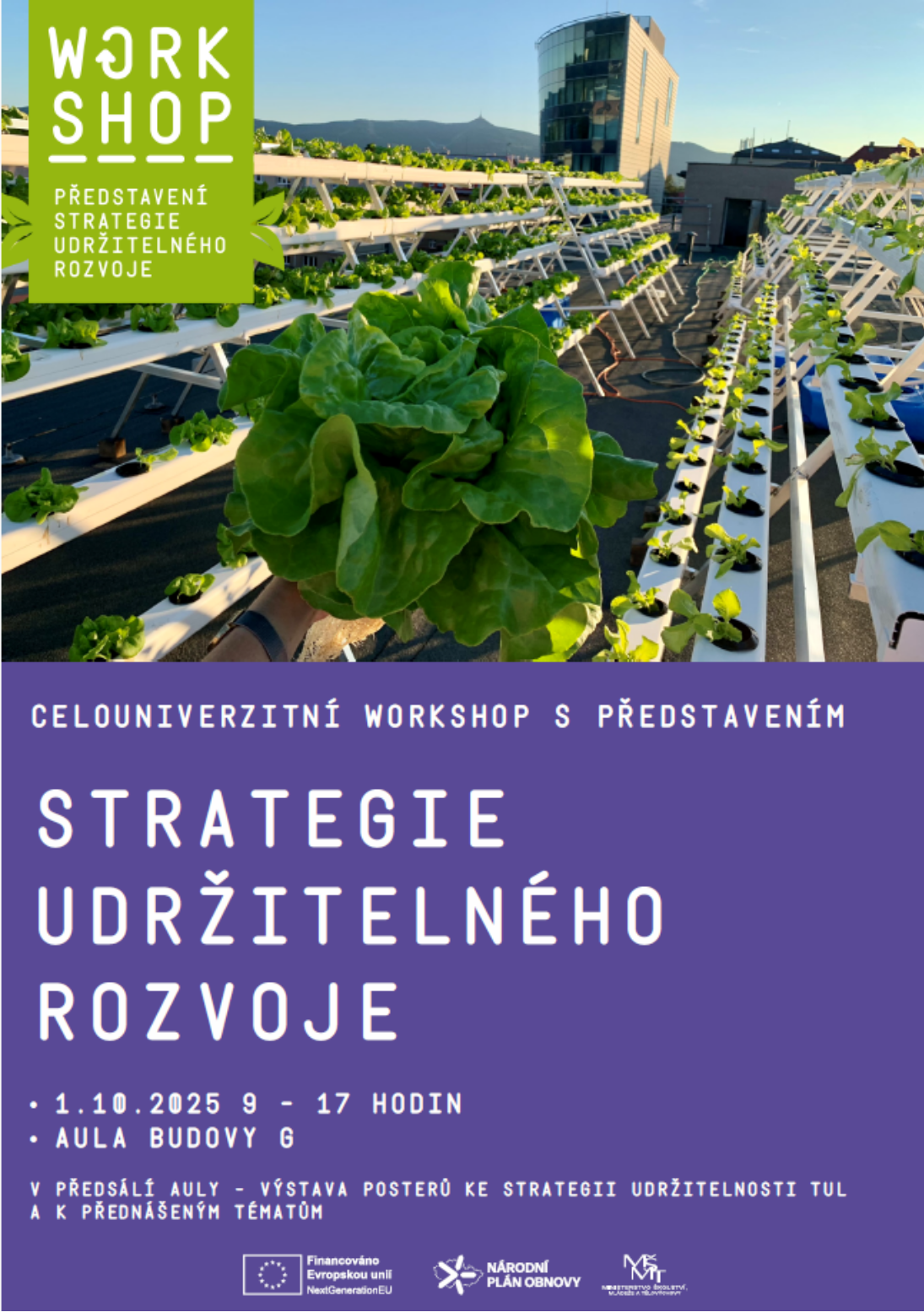
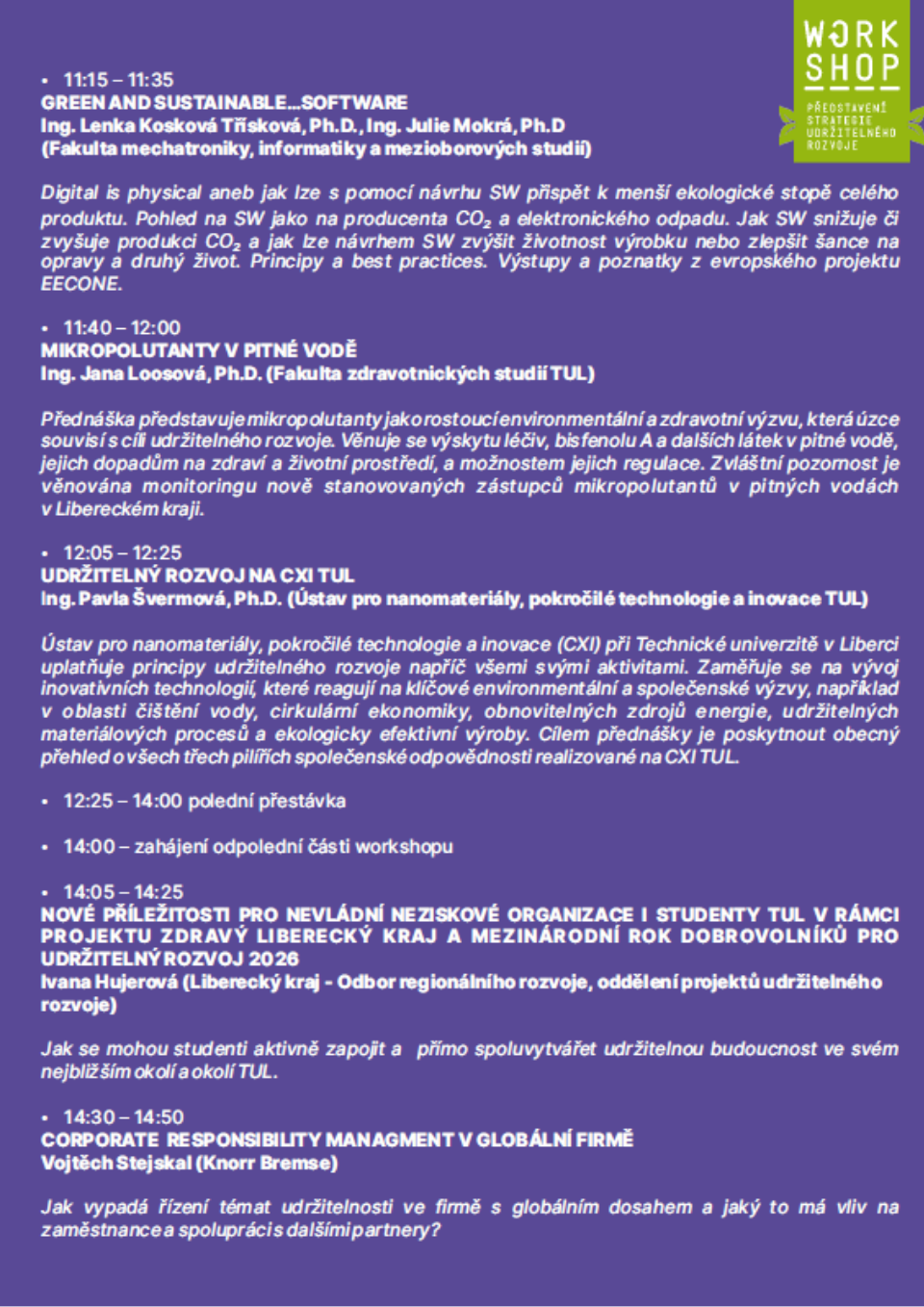
- Presentation by Ing. Zuzana Vyoralová, Ph.D., at the TUL Sustainable workshop with a lecture titled “Sustainable Trends in Building Design, Construction, and Operation” during the morning session, in which individual TUL faculties and institutes were introduced.
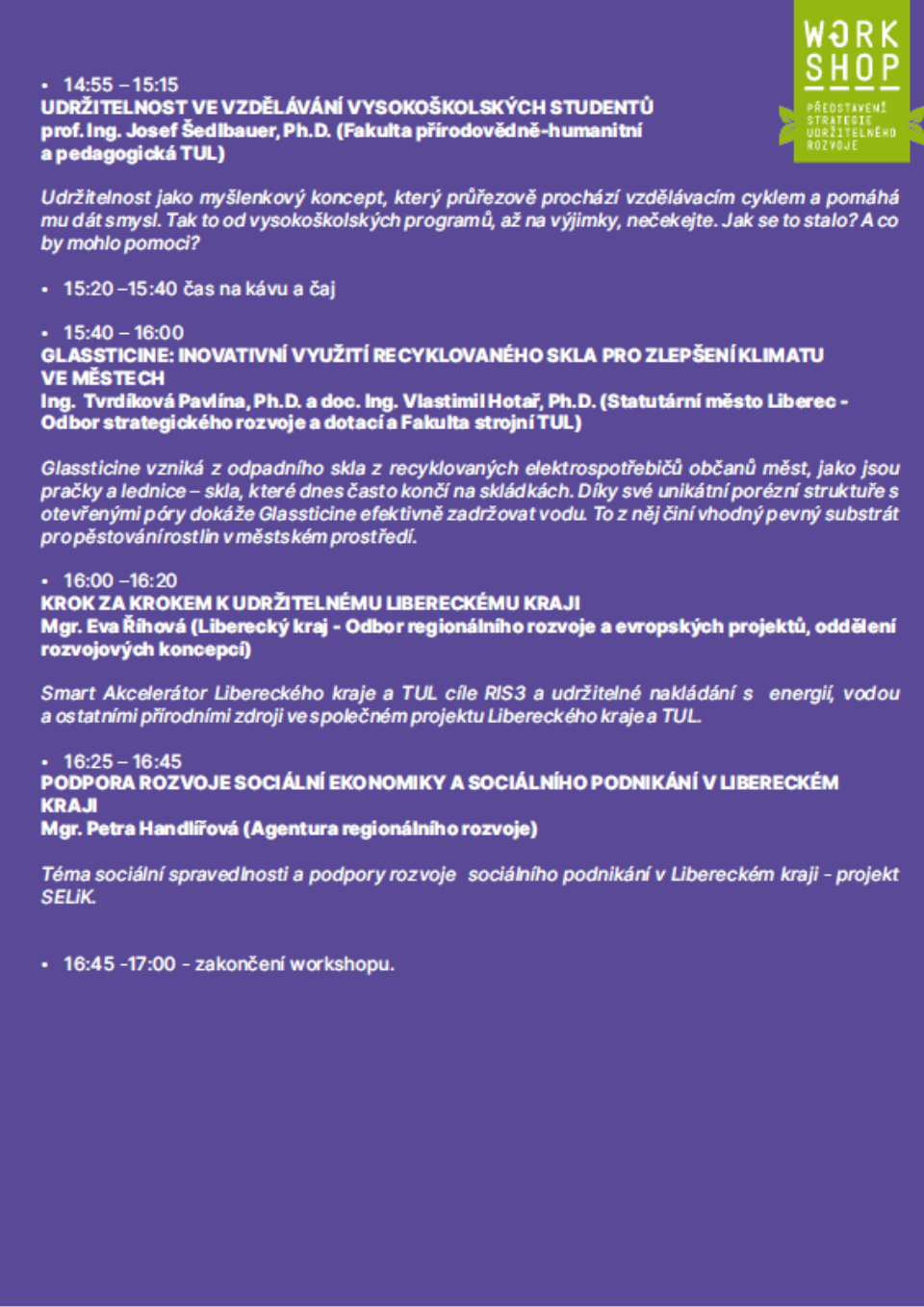
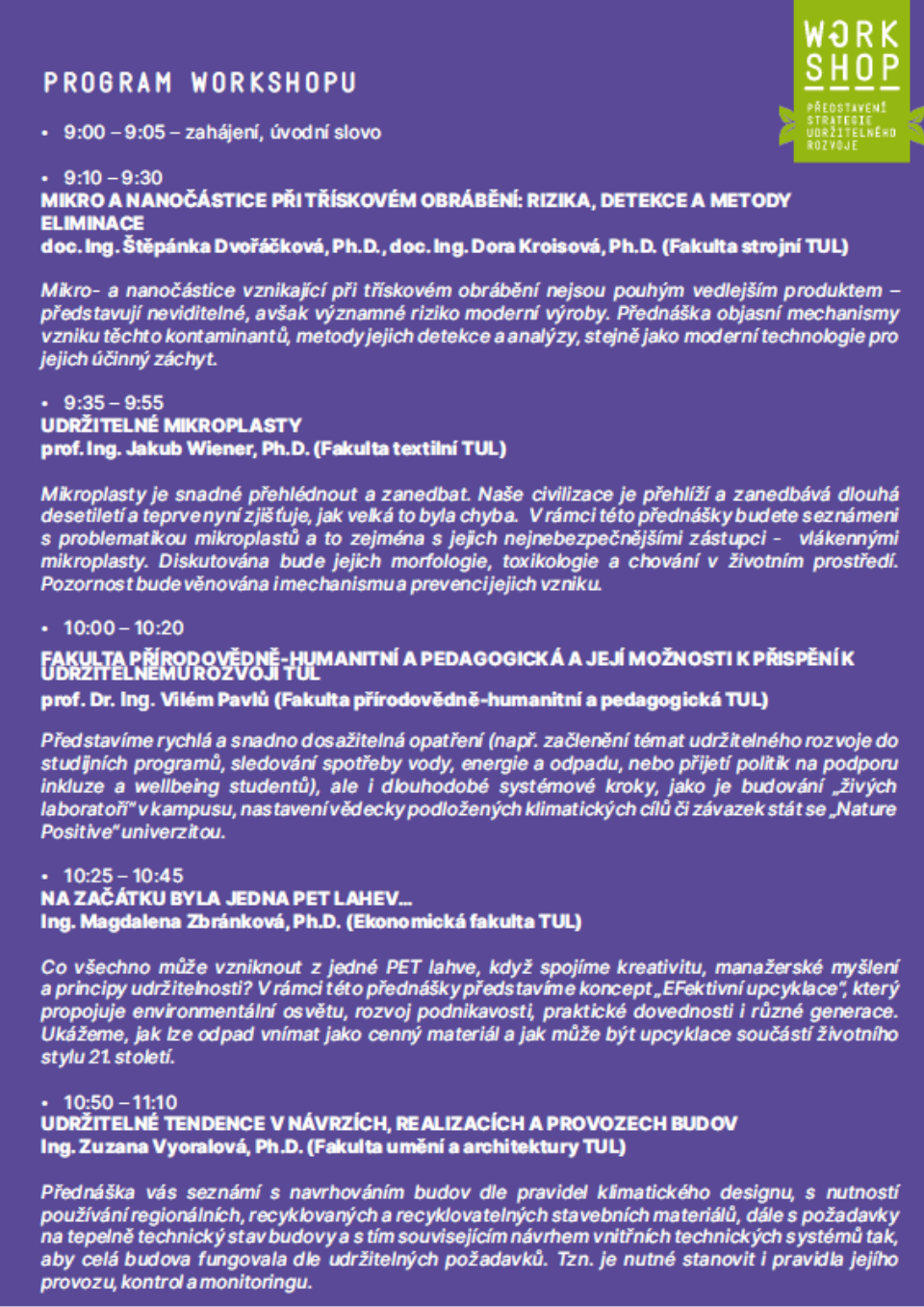
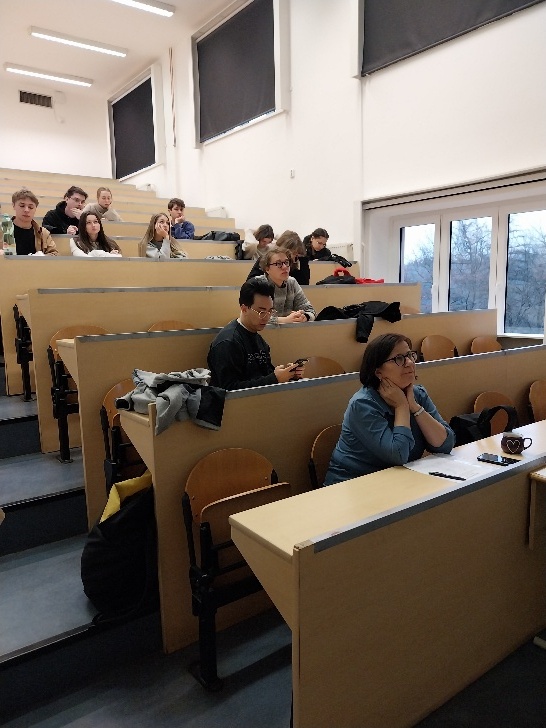
- In the winter semester of 2025–26, the FUA launched a new master’s-level course titled “Sustainable Construction.” The course aims to introduce students to alternative approaches and possibilities in building and land-use design that are closely linked to a fundamentally different, more responsible approach to design. The primary objective is to consider the environmental impact of construction and reduce the carbon footprint of buildings and sites. Educators and experts from various professions involved in the implementation of construction projects or site development have joined the course’s teaching. Individual topics integrated all aspects of building design within a given site.
Lecture topics:
- Natural Structures and Architecture
- Territory and Site – Site Permeability, Accessibility, Land Use Planning
- Resilient urban structure
- The Relationship Between Architecture and Climate
- Sustainable and low-carbon systems in building and transportation infrastructure
- Structural Systems and Construction Sustainability
- Thermal and technical requirements for buildings
- Accessibility in sustainable construction
- Sustainable technical systems
- Water management in buildings and on adjacent land
- Sustainable lighting concepts inside and outside buildings
- Artificial intelligence and sustainability in contemporary architecture
- On December 17, 2025, a student workshop was held with topics based on the course Sustainable Construction:
- Is Venice sustainable? Venice is sustainable. - Based on the field trip, your own observations, and research, can Venice, Italy, be considered a sustainable city? If so, list and document its sustainable features.
- Your own studio project. Is your design sustainable as a whole or at least in some of its parts? If so, in what ways are they sustainable and how do they relate to the environment?
- Choose one of the topics that was presented and that resonated with you. Find specific projects related to the topic and describe their sustainable aspects.
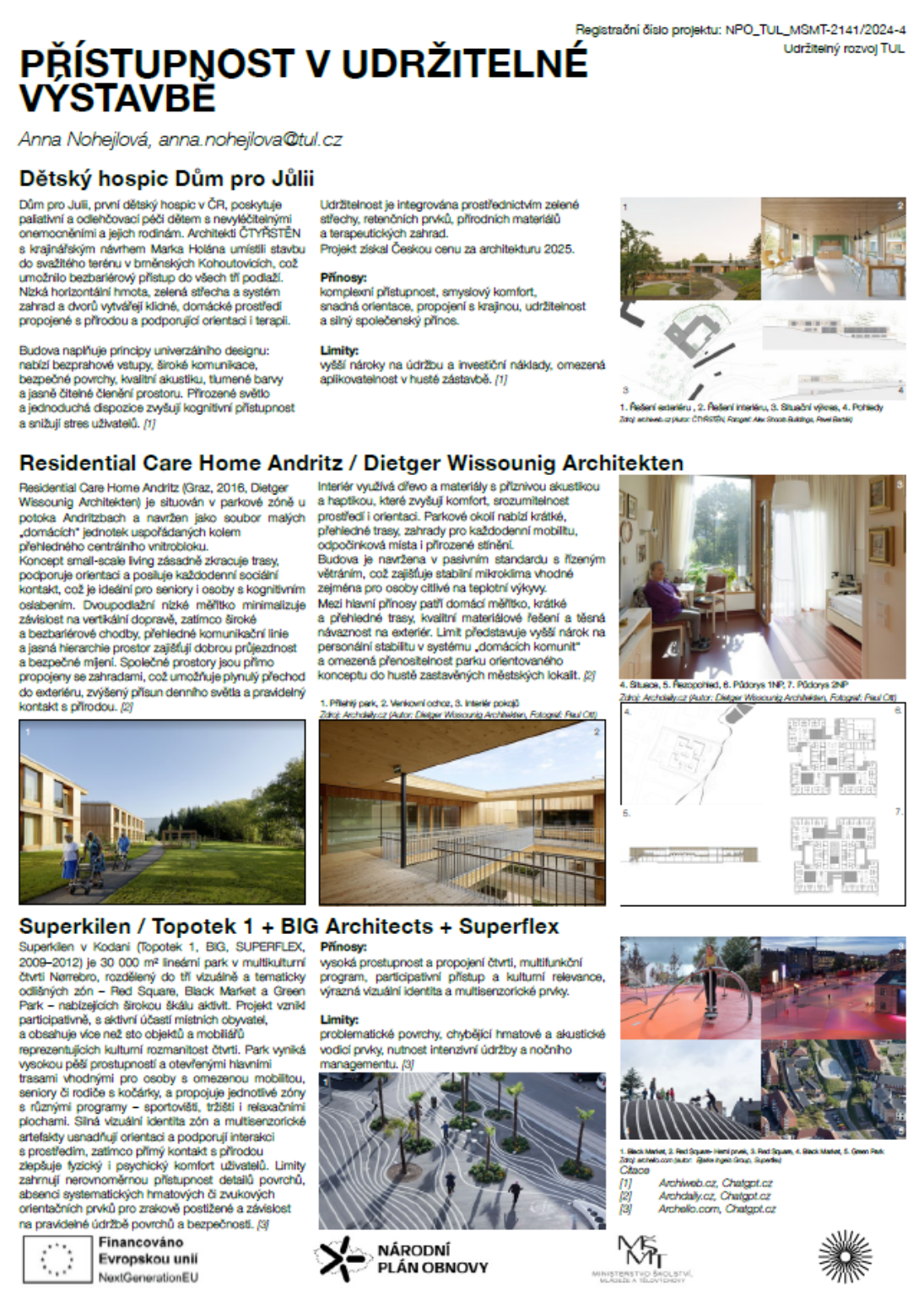
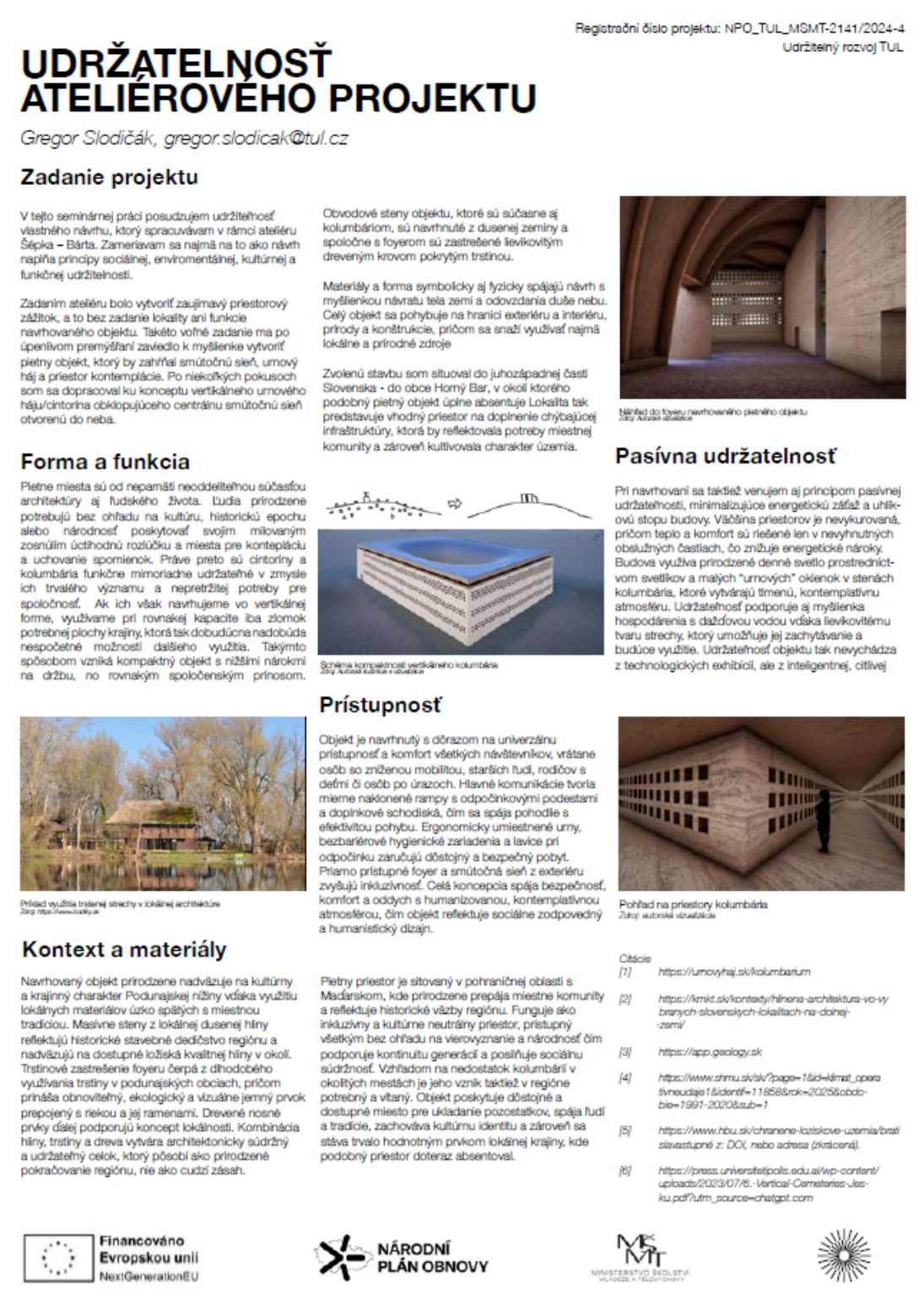
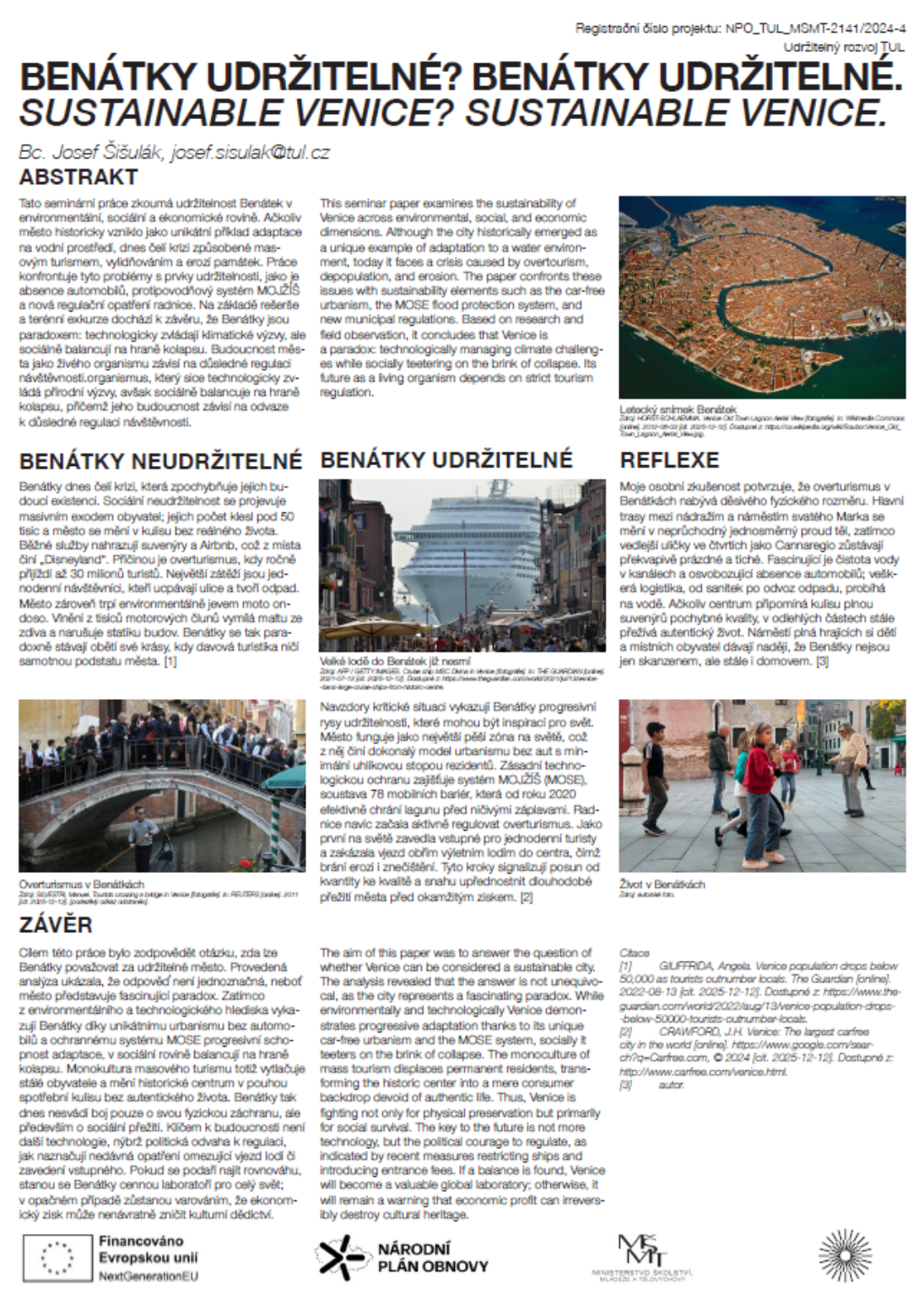
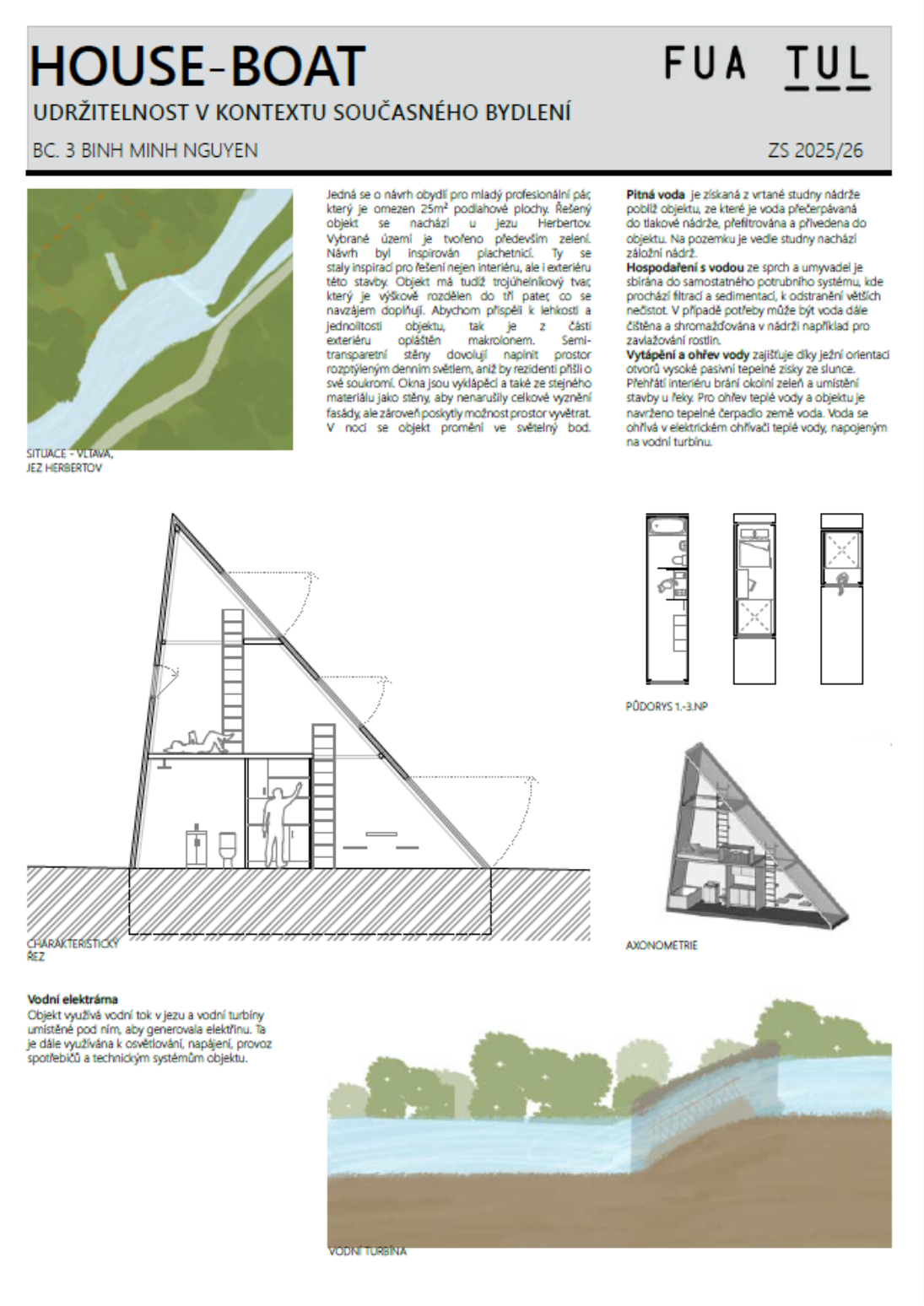
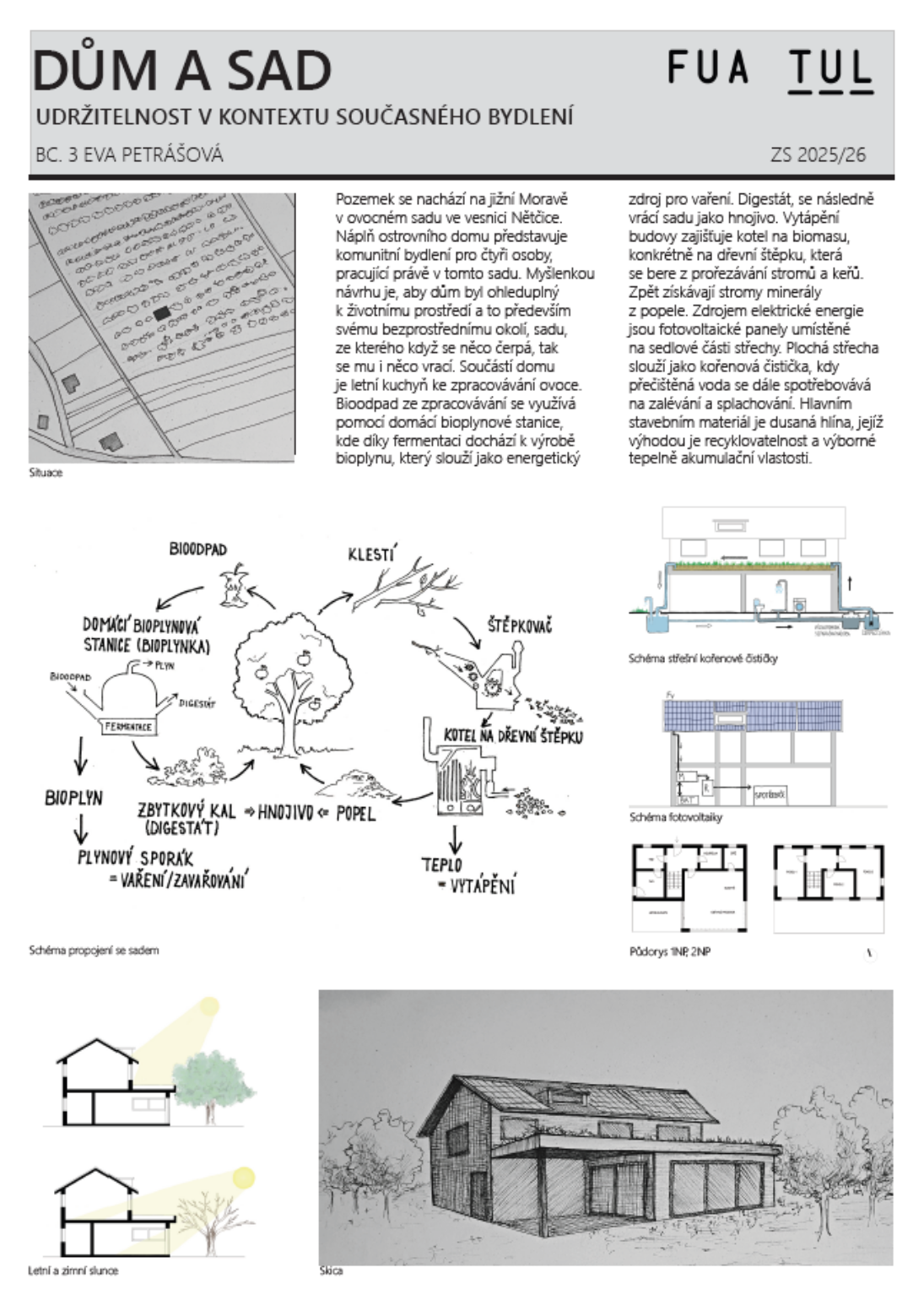
- On Thursday, December 18, 2025, a student workshop was held on the design of a sustainable ISLAND/HYBRID single-family home based on the principles of “passive architecture,” including water management within the building and on the property, as well as waste management. Third-year students in the Bachelor’s program in Architecture and Urban Planning designed small structures with elements intended to harmonize with the environment, i.e., featuring sustainable characteristics.
Lasting changes in energy use:
- Do not waste water
- sort waste
- recycle sorted waste (paper, cardboard, etc.)
- Do not overheat offices
- Install a dishwasher in the kitchenette
- Turn on the lights only when someone is in the room
- Always turn off the lights